Showing posts with label Scenario based questions. Show all posts
Showing posts with label Scenario based questions. Show all posts
10 September 2022

26 June 2020
SQL / ORACLE- Scenario Based Interview Questions & Answers PART- 17
Problem Statement:-
Order_Tbl has four columns namely ORDER_ID, PRODUCT_ID, QUANTITY and PRICE.
ORDER_Tbl Table

Write a SQL query that will explode the above data into single unit level records as shown below.
OUTPUT TABLE

SOLUTION
MT.Order_ID,
MT.Product_ID,
1 AS quantity
FROM
ORDER_TABLE MT
INNER JOIN
(
SELECT 1 AS nbr UNION ALL SELECT 2 AS nbr UNION ALL
SELECT 3 AS nbr UNION ALL SELECT 4 AS nbr UNION ALL SELECT 5 AS nbr
) N ON N.nbr <= MT.quantity
Using Recursive CTE
(
-- Anchor Query
Select Order_ID,Product_ID, 1 As Quantity,1 As Cnt
FROM ORDER_TABLE
UNION ALL
-- Recursive Part
Select A.Order_ID,A.Product_ID, B.Quantity,B.Cnt+1
FROM ORDER_TABLE As A INNER JOIN CTE_Order As B
ON A.Product_ID=B.Product_ID WHERE B.Cnt+1 <= A.Quantity
)
Select Order_ID,Product_ID, Quantity
FROM CTE_Order
ORDER BY Product_ID,Order_ID
Kindly refer to YouTube video for more details and Don't forget to like and subscribe.
23 June 2020
SQL / ORACLE- Scenario Based Interview Questions & Answers PART- 16
Problem Statement:-
Order_Tbl has four columns namely ORDER_DAY, ORDER_ID, PRODUCT_ID, QUANTITY and PRICE
Order_Tbl Table

PART A
Write a SQL query to get the highest sold Products (Quantity*Price) on both days.
OUTPUT TABLE

PART B
Write a SQL query to get all product's total sales on 1st May and 2nd May adjacent to each other.
OUTPUT TABLE

PART C
Write a SQL query to get all products day wise, that was ordered more than once.
OUTPUT TABLE

SOLUTION
PART A
SELECT A.ORDER_DAY,B.PRODUCT_ID ,A.Sold_AmountFROM (
(SELECT ORDER_DAY, MAX(QUANTITY*PRICE)as Sold_Amount
FROM Order_Tbl GROUP BY ORDER_DAY) A
INNER JOIN
(SELECT ORDER_DAY ,PRODUCT_ID,QUANTITY*PRICE As Sold_Amount
FROM Order_Tbl ) B
ON A.ORDER_DAY =B.ORDER_DAY AND A.Sold_Amount=B.Sold_Amount)
SELECT PRODUCT_ID,
SUM(ISNULL(Sales_01,0)) As Total_Sales_01,
SUM(ISNULL(Sales_02,0)) As Total_Sales_02
FROM
(
SELECT PRODUCT_ID,
CASE WHEN ORDER_DAY ='2015-05-01' THEN Total_Sales END as 'Sales_01',
CASE WHEN ORDER_DAY ='2015-05-02' THEN Total_Sales END as 'Sales_02'
FROM(
SELECT ORDER_DAY,PRODUCT_ID, SUM(QUANTITY*PRICE) As Total_Sales
FROM Order_Tbl
GROUP BY ORDER_DAY,PRODUCT_ID) A
)B
ISNULL([2015-05-01],0) As Total_Sales_01,
ISNULL([2015-05-02],0) As Total_Sales_02
FROM
(
SELECT ORDER_DAY,PRODUCT_ID, QUANTITY*PRICE As Total_Sales
FROM Order_Tbl )BaseTble
PIVOT(
SUM(Total_Sales)
FOR ORDER_DAY IN ([2015-05-01],[2015-05-02])
FROM Order_Tbl
GROUP BY ORDER_DAY,PRODUCT_ID
PART B
SUM(ISNULL(Sales_01,0)) As Total_Sales_01,
SUM(ISNULL(Sales_02,0)) As Total_Sales_02
FROM
(
SELECT PRODUCT_ID,
CASE WHEN ORDER_DAY ='2015-05-01' THEN Total_Sales END as 'Sales_01',
CASE WHEN ORDER_DAY ='2015-05-02' THEN Total_Sales END as 'Sales_02'
FROM(
SELECT ORDER_DAY,PRODUCT_ID, SUM(QUANTITY*PRICE) As Total_Sales
FROM Order_Tbl
GROUP BY ORDER_DAY,PRODUCT_ID) A
)B
GROUP BY PRODUCT_ID
SELECT PRODUCT_ID,Using PIVOT Function
ISNULL([2015-05-01],0) As Total_Sales_01,
ISNULL([2015-05-02],0) As Total_Sales_02
FROM
(
SELECT ORDER_DAY,PRODUCT_ID, QUANTITY*PRICE As Total_Sales
FROM Order_Tbl )BaseTble
PIVOT(
SUM(Total_Sales)
FOR ORDER_DAY IN ([2015-05-01],[2015-05-02])
) As Pivot_Table
SELECT ORDER_DAY,PRODUCT_IDPART C
FROM Order_Tbl
GROUP BY ORDER_DAY,PRODUCT_ID
HAVING COUNT(*) > 1
Kindly refer to YouTube video for more details and Don't forget to like and subscribe.
22 June 2020
SQL / ORACLE- Scenario Based Interview Questions & Answers PART- 15
Problem Statement:-
Order_Tbl has four columns namely ORDER_DAY, ORDER_ID, PRODUCT_ID, QUANTITY, and PRICE
Order_Tbl Table

PART A
Write a SQL query to get all the products that got sold on both the days and the number of times the product is sold.
OUTPUT Table

PART B
Write a SQL query to get products that were ordered on 02-May-2015 but not on 01-May-2015.
OUTPUT Table

SOLUTION
PART A
SELECT PRODUCT_ID,COUNT(PRODUCT_ID) AS [COUNT],Count(distinct ORDER_DAY)
FROM Order_Tbl
GROUP BY PRODUCT_ID
HAVING Count(distinct ORDER_DAY) > 1
PART B
Using Subquery
SELECT DISTINCT(PRODUCT_ID) FROM Order_Tbl
WHERE ORDER_DAY = '2015-05-02'
AND PRODUCT_ID NOT in (
SELECT PRODUCT_ID from Order_Tbl where ORDER_DAY =
'2015-05-01')
Using Join
SELECT A.PRODUCT_ID--,B.PRODUCT_ID
FROM (
(
SELECT PRODUCT_ID
FROM Order_Tbl WHERE
ORDER_DAY='2015-05-02'
)A
LEFT JOIN
(
SELECT PRODUCT_ID
FROM Order_Tbl WHERE
ORDER_DAY='2015-05-01'
)B
ON A.PRODUCT_ID=B.PRODUCT_ID
)
WHERE B.PRODUCT_ID IS NULL
Using EXCEPT Query
SELECT PRODUCT_ID
FROM Order_Tbl WHERE
ORDER_DAY='2015-05-02'
EXCEPT
SELECT PRODUCT_ID
FROM Order_Tbl WHERE ORDER_DAY='2015-05-01'
Kindly refer to YouTube video for more details and Don't forget to like and subscribe.
4 September 2016
SQL / ORACLE- Scenario Based Interview Questions & Answers PART- 11
SCENARIO:
We have EMP_DETAILS table which contains employee details such as EMPID, GENDER,EMAILID and DEPT_ID columns. We want to display all emailid associated with a particular DEPT_ID to be concatenated with semicolon as shown below.
EMP_DETAILS Table
EMPID
|
GENDER
|
EMAILID
|
DEPT_ID
|
1111
|
M
|
YYYYY@gmaix.com
|
104
|
2222
|
M
|
ZZZ@gmaix.com
|
103
|
3333
|
F
|
AAAAA@gmaix.com
|
102
|
4444
|
F
|
PP@gmaix.com
|
104
|
5555
|
M
|
CCCC@yahu.com
|
101
|
6666
|
M
|
DDDDD@yahu.com
|
100
|
7777
|
F
|
E@yahu.com
|
102
|
8888
|
M
|
M@yahu.com
|
102
|
9999
|
F
|
SS@yahu.com
|
100
|
EXPECTED RESULT:
27 August 2016
SQL / ORACLE- Scenario Based Interview Questions & Answers PART- 10
Consider below two tables Table_First and Table_Second for answering the below questions. Basically you will be able to check your JOIN concepts. Take your time and ponder over and then try answer questions. It is easy but very conceptual.
SELECT * FROM Table_First;
SELECT * FROM Table_Second;
Take pen and paper and then try to solve SQL query.
Q1.What will be the ouput if we are doing INNER JOIN between the above two tables as follows:
SELECT X,Y
FROM Table_First F
INNER JOIN Table_Second S
ON F.X=S.Y;
 |
| Table_First |
 |
| Table_Second |
Q1.What will be the ouput if we are doing INNER JOIN between the above two tables as follows:
SELECT X,Y
FROM Table_First F
INNER JOIN Table_Second S
ON F.X=S.Y;


13 August 2016
SQL- Scenario Based Questions PART- 8
SCENARIO:
Table Employee_Details has Gender column. In this Gender column M should be updated with F and F should be updated with M. |
| Employee_Details |
3 August 2016
SQL- Scenario Based Questions PART- 7
SCENARIO: We have table EMPLOYEE_INFO which contains Employee information. We want to display all characters before '@' in EMAILID field as Name field. Please see below in details.
TABLE NAME: EMPLOYEE_INFO
 |
| Employee_info Table |
EXPECTED RESULT:
1 August 2016
SQL- Scenario Based Questions PART- 6
SCENARIO: We have table COUNTRY_INFO which contains country names. Country_name field has some junk characters. Those junk characters are listed in Value_1 column. Those junk characters in Country_name need to be replaced with value_2 values for all occurrences while displaying. Please see below the scenario in details.
TABLE NAME: COUNTRY_INFO
 |
COUNTRY_INFO Table |
EXPECTED RESULT:
31 July 2016
SQL- Scenario Based Questions PART- 5
SCENARIO: We have table EMPLOYEE_INFO which contains Employee information. We want the output table should display NAME field and it should contain EMPNAME field values leaving behind first and last character in it. Please see below in details.
TABLE NAME: EMPLOYEE_INFO
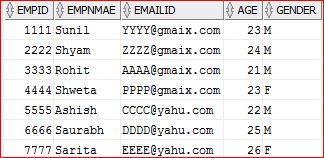 |
| EMPLOYEE_INFO Table |
EXPECTED RESULT:
29 May 2016
SQL- Scenario Based Questions PART- 4
SQL- Scenario Based Questions PART- 4
SCENARIO:
Suppose there is a table which contains a column NetBalance which has both negative and positive values. Now you have to write a query to dispaly sum of all positive Balances and sum of all negative Balances.
Consider below BalanceInfo table for answering this scenario based questions:-
BalanceInfo Table
3 May 2015
SQL- Scenario Based Questions PART- 3
Q. How to get distinct rows from SQL table without using DISTINCT keyword .
CREATE TABLE ProductDetail
( ProductID Int,
ProductName Varchar(30),
Price int)
INSERT INTO ProductDetail Values(101,'Dove',55)
INSERT INTO ProductDetail Values(101,'Dove',55)
INSERT INTO ProductDetail Values(102,'Hamam',30)
INSERT INTO ProductDetail Values(103,'Cinthol',35)
INSERT INTO ProductDetail Values(103,'Cinthol',35)
To achieve distinct records from a table, we can do by following two methods:
Solution#2: By using UNION . We know that UNION always gives distinct record from a table. So By doing UNION between the same table will give unique records.
CREATE TABLE ProductDetail
( ProductID Int,
ProductName Varchar(30),
Price int)
INSERT INTO ProductDetail Values(101,'Dove',55)
INSERT INTO ProductDetail Values(101,'Dove',55)
INSERT INTO ProductDetail Values(102,'Hamam',30)
INSERT INTO ProductDetail Values(103,'Cinthol',35)
INSERT INTO ProductDetail Values(103,'Cinthol',35)
 |
| ProductDetail |
Solution#1: By using GROUP BY clause. By selecting all columns and then grouping by all columns gives distinct records.
SELECT ProductID,ProductName,Price
FROM ProductDetail
GROUP BY ProductID,ProductName,Price
 |
| Solution#1_ProductDetail |
SELECT ProductID,ProductName,Price
FROM ProductDetail
UNION
SELECT ProductID,ProductName,Price
FROM ProductDetail
 |
| Solution#2_ProductDetail |
For other SQL Scenario Based Questions, please visit below link
http://itjunction4all.blogspot.com/2014/04/sql-scenario-based-questions-part-2.html
http://itjunction4all.blogspot.com/2014/04/sql-scenario-based-questions-part-2.html
26 April 2014
SQL- Scenario Based Questions PART- 2
Consider below Employee table and Department table for answering the questions:-
Employee Table:
 |
| EMPLOYEE TABLE |
Department Table:
 |
| DEPARTMENT TABLE |
SELECT EmpName,DeptName,Location FROM Employee E
INNER JOIN Department D
ON E.DeptNo=D.DeptNo
Q2.Write a SQL query to display total number of Employee and maximum salary under each Department Name .
Q2.Write a SQL query to display total number of Employee and maximum salary under each Department Name .
SELECT D.DeptName,
Max(Salary)As MaxSalary,
COUNT(EmpName) As TotEmp
FROM Department D
LEFT OUTER JOIN Employee E
ON E.DeptNo=D.DeptNo
GROUP BY D.DeptName

Q2.Write a SQL query to list maximum salary, minimum salary and average salary designationwise, for department 200 and display only those records which has average salary greater than 10000.
SELECT E.Designation,
Max(Salary)As MaxSalary,
Min(Salary)As MinSalary,
AVG(Salary) As AvgSalary
FROM Employee E
INNER JOIN Department D
ON E.DeptNo=D.DeptNo
WHERE D.DeptNo=200
GROUP BY E.Designation
HAVING AVG(Salary) > 10000

Max(Salary)As MaxSalary,
COUNT(EmpName) As TotEmp
FROM Department D
LEFT OUTER JOIN Employee E
ON E.DeptNo=D.DeptNo
GROUP BY D.DeptName
Q2.Write a SQL query to list maximum salary, minimum salary and average salary designationwise, for department 200 and display only those records which has average salary greater than 10000.
SELECT E.Designation,
Max(Salary)As MaxSalary,
Min(Salary)As MinSalary,
AVG(Salary) As AvgSalary
FROM Employee E
INNER JOIN Department D
ON E.DeptNo=D.DeptNo
WHERE D.DeptNo=200
GROUP BY E.Designation
HAVING AVG(Salary) > 10000
If you like this post, please do share by clicking on G+1 Button below :
Subscribe to:
Posts (Atom)